
What Private, Semi-Private, and Group German Classes Offer
Safah Academy delivers live, online German lessons in three formats, all built around speaking:
- Private lessons (one student + one teacher, $40/hour) give full attention, custom pacing, and immediate feedback on exactly the grammar, vocabulary, or pronunciation the student needs.
- Semi-private lessons (very small class, $20/hour) combine shared conversation practice with still-high individual attention.
- Group lessons (small group, $20/hour) adds higher level of peer interaction, games, and turn-taking while ensuring every voice is heard.

All formats use themed conversations, listening activities, vocabulary, grammar moments, and speaking practice. Lessons are taught from a language the student already knows and are led by dedicated native speaking teachers. The value is practical: more speaking time than a typical classroom, flexible in choosing your weekly cadence, and content that stays relevant instead of following a rigid textbook sequence.
Research on instructional formats consistently shows that one-to-one and very small-group settings increase speaking opportunity and personalization. Benjamin Bloom’s classic work on tutoring highlighted large gains from individualized instruction; later reviews confirm meaningful benefits for personalized feedback and pacing even if the original “2 sigma” figure is debated. For language learners, the practical result is faster progress on the skills that matter most: speaking and listening.
CEFR Levels A1 to C2 and Adaptive Teaching
Safah Academy teaches the full range of the Common European Framework of Reference for Languages (CEFR), from absolute beginners (A1) to near-native proficiency (C2).
According to the Council of Europe and the Goethe-Institut:
- A1–A2 (Basic user): A beginner speaker who uses everyday expressions, simple introductions, routine exchanges about familiar topics.
- B1–B2 (Independent user): An intermediate speaker who can handle travel, work, and social situations; discuss experiences and opinions with increasing fluency.
- C1–C2 (Proficient user): An advanced speaker who uses German flexibly for academic, professional, or complex social purposes, including nuanced expression.
While students can self evaluate themselves when booking their lesson through Safah Academy, students are also evaluated in the first lesson through introductions, conversation, and a quick sense of level. From there, every subsequent class adapts: the teacher selects themes, adjusts complexity, inserts grammar only when useful, and targets the student’s specific gaps. This is where Safah Academy stands out, as our lessons are not one-size-fits-all. A beginner working toward basic travel German receives scaffolded speaking practice; an intermediate professional preparing for work conversations gets targeted role-play and feedback; an advanced learner refines nuance and spontaneous discussion.
This adaptive approach aligns with how language proficiency is actually built. The Goethe-Institut and universities (via DAAD guidance) use CEFR descriptors to define what learners can do, not merely what grammar they have covered. Adaptive conversational lessons move students toward those real-world abilities more efficiently than fixed curricula.
The Conversational Solution: Speaking Practice with a Teacher
The core solution is deliberate conversational practice. Students do not only study German, they use it. Themed lessons (e.g. introductions, stories, debates, games, expressions, cultural topics) create repeated opportunities to listen and speak. A skilled teacher acts as a conversation partner who models natural language, provides real-time correction, and keeps the exchange slightly above the student’s current comfort zone.
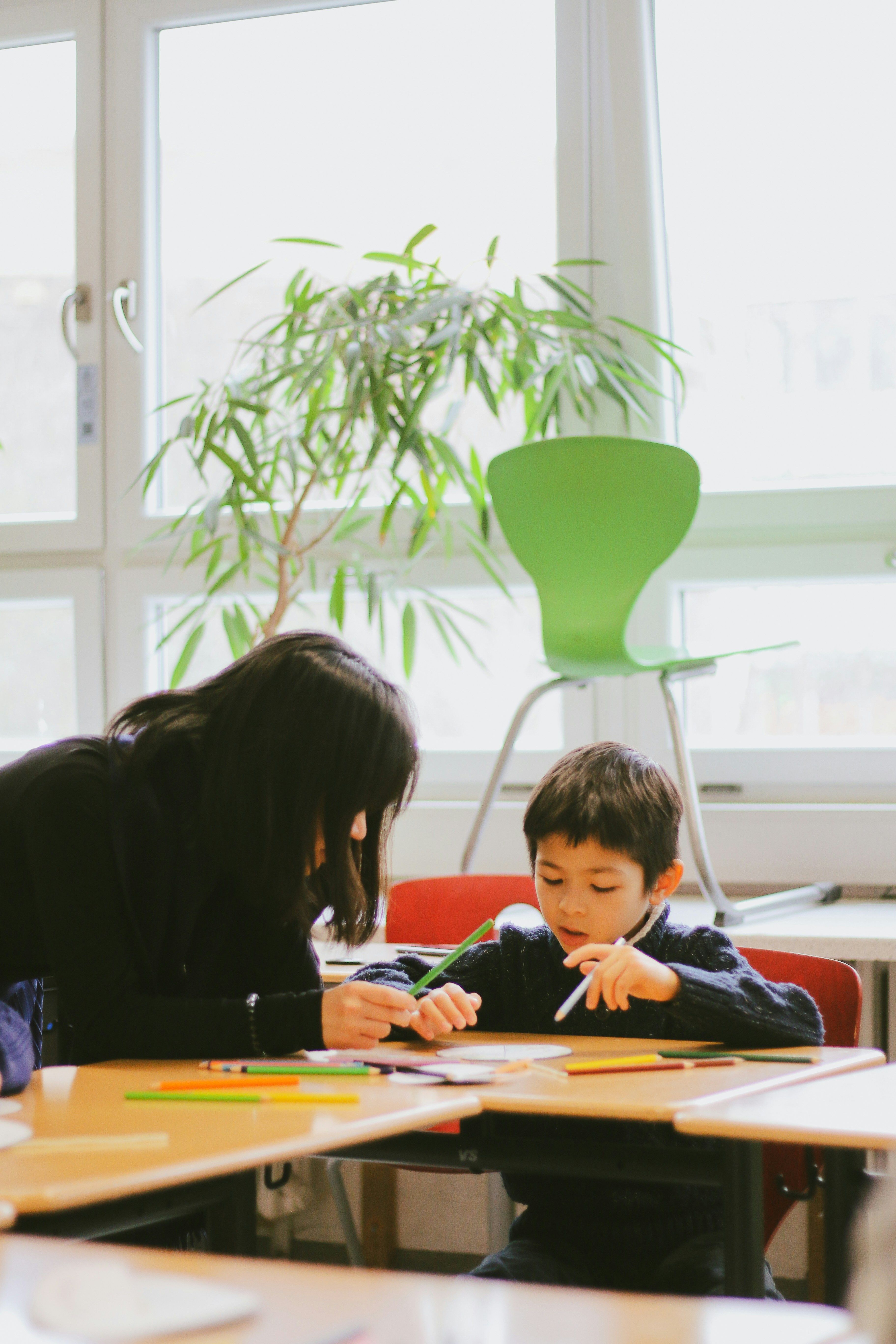
Linguist Merrill Swain’s Output Hypothesis explains why this works. Producing language (speaking) helps learners notice gaps in their knowledge, test hypotheses about grammar and vocabulary, and receive feedback that refines accuracy and fluency. Input alone is not enough; pushed, meaningful output accelerates retention and automaticity. Having a consistent speaking partner, especially one who can guide and correct, gives the repetition-in-context that turns declarative knowledge into usable skill. Native-level or highly proficient modeling further improves pronunciation, natural phrasing, and cultural nuance that textbooks rarely capture.
Whether in private (maximum speaking time and customization), semi-private, or group settings (peer exposure plus teacher support), the result is the same: students practice the language they need for real situations, from ordering food at A1 to professional discussions at C1/C2.
How This Looks in Practice
A new A1 student might start with guided introductions and simple questions, receiving immediate modeling and correction so basic phrases become automatic. A B1 learner preparing for travel or work joins themed role-plays and short discussions, with the teacher adapting vocabulary and grammar support on the spot. An advanced C1 student works on nuance, argumentation, or specialized topics, using the session to refine spontaneous speech. Across formats, games and conversation keep engagement high while the teacher ensures the content matches the individual’s goals and level. Progress compounds because every lesson builds directly on what that student demonstrated in previous sessions.
Conclusion
Private, semi-private, and group German online classes at Safah Academy give learners from A1 to C2 exactly the combination that drives real progress: adaptive content, high speaking time, themed conversational practice, and consistent teacher support. The formats let students choose the balance of personalization, cost, and social interaction that fits their life, while the method ensures they actively use German rather than only study it.
Ready to experience the difference?
Book your spot with Safah Academy for a live online German lesson today.
References
- Council of Europe. Common European Framework of Reference for Languages (CEFR): Learning, teaching, assessment. Available at: https://www.coe.int/en/web/common-european-framework-reference-languages
- Goethe-Institut. German language levels A1–C2 aligned with the CEFR. Available at: https://www.goethe.de/ins/de/en/uun/dln/ger.html
- German Academic Exchange Service (DAAD). Requirements overview for studying in Germany, including language proficiency. Available at: https://www.daad.de/en/studying-in-germany/requirements/overview/
- Swain, M. (1985/2005). The output hypothesis: Theory and research. In Handbook of Research in Second Language Teaching and Learning. Summary overview: https://en.wikipedia.org/wiki/Comprehensible_output_hypothesis
- Bloom, B. S. (1984). The 2 sigma problem: The search for methods of group instruction as effective as one-to-one tutoring. Educational Researcher, Volume 13, Issue 6, Available at: https://journals.sagepub.com/doi/10.3102/0013189X013006004